how to read an RNG audit report Key Takeaways
A RNG audit report is the single most important piece of evidence that an online casino operates fairly.
- Understand what an RNG audit report actually proves and what its limitations are.
- Spot key sections across iTech Labs, GLI, and eCogra reports, including test parameters and confidence levels.
- Identify red flags such as missing scope, expired certificates, or vague language.
Why Understanding an RNG Audit Report Matters for Player Trust
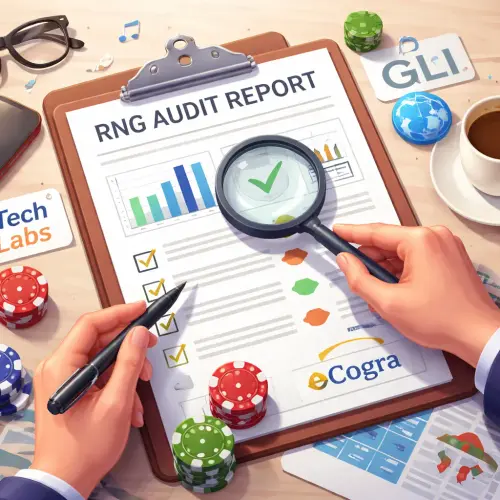
A RNG audit report is the single most important piece of evidence that an online casino operates fairly. Without it, players are essentially trusting the house blindfolded. Regulators and testing labs like iTech Labs, GLI (Gaming Laboratories International), and eCogra put games through rigorous statistical tests to confirm that outcomes are unpredictable and unbiased. When you know how to read one of these reports, you move from being a passive player to an informed one. For a related guide, see Certifications That Actually Matter – eCogra, GLI, iTech Labs.
These reports aren’t just technical documents; they’re your guarantee that the odds you see on a slot machine or blackjack table are mathematically sound. The process typically involves running millions of simulated rounds and checking the output against expected distributions. The report then documents the tests performed, the results, and the lab’s certification.
Step 1: Locate the Report and Confirm Its Scope
Before diving into numbers, first find the how to read an RNG audit report approach that applies to your specific document. Trusted casinos usually link to reports directly in their footer or under a “Fairness” page. The report should clearly state which games or software providers it covers.
What to Look for in the Header
Every report starts with a header containing the testing lab’s name (iTech Labs, GLI, or eCogra), the date of testing, and the certificate number. Check the date. A report older than two years may still be valid if the software hasn’t changed, but top-tier casinos refresh audits annually. Also confirm that the report covers the specific game or game provider you care about, not just a generic platform audit.
Example: iTech Labs Report Scope Section
iTech Labs reports typically list “Scope of Testing” on the first page. If you see “Random Number Generator for Casino Platform v3.2,” but you’re playing a slot from a different provider, that report doesn’t cover your game. Always match the scope to your play.
Step 2: Understand the Statistical Tests Performed
The core of any RNG audit report is the set of statistical tests applied to the RNG output. These tests check for patterns, biases, and predictability. Three common tests you’ll encounter are the Chi-Square test, the Runs test, and the Serial Correlation test.
Chi-Square Test
This test compares the observed distribution of numbers against an expected uniform distribution. A low Chi-Square value (or a p-value above 0.05) means the RNG is producing numbers that appear random. Most reports will show the p-value directly.
Runs Test and Serial Correlation
The Runs test checks for alternating patterns (like win-lose-win-lose), while the Serial Correlation test looks for dependencies between consecutive numbers. For example, GLI reports often include a table with “Test Name,” “Result,” and “Pass/Fail” columns. A “Pass” means the RNG passed that specific test.
| Test | What It Checks | Typical Pass Criteria |
|---|---|---|
| Chi-Square | Uniformity of distribution | p-value > 0.01 or 0.05 |
| Runs Test | Pattern alternation | Z-score within ±1.96 |
| Serial Correlation | Independence between consecutive numbers | Correlation near 0 |
Step 3: Compare iTech Labs, GLI, and eCogra Report Styles
Each lab presents its findings differently. Knowing these differences will speed up your reading. iTech Labs reports are often detailed PDFs with appendices, GLI reports tend to be concise with a clear pass/fail summary, and eCogra reports are more narrative-driven.
iTech Labs Report Characteristics
iTech Labs typically provides a multi-page document. The first page has a bright summary box showing the certificate number, date, and overall verdict. Inside, you’ll find a table of tests with detailed statistical values. iTech Labs often includes a section on the RNG algorithm’s seeding process, which adds an extra layer of transparency.
GLI (Gaming Laboratories International) Report Characteristics
GLI reports are very structured. They start with the “Certificate of Approval” which states the product name and version. Then follows a “Test Results Summary” with a simple pass/fail for each test. GLI reports are probably the easiest to scan for a quick verdict. Look for the “GLI Certification” logo and certificate number—these can be cross-referenced on the GLI website.
eCogra Report Characteristics
eCogra, or e-Commerce and Online Gaming Regulation and Assurance, produces reports that are more narrative. They usually include a “Test Methodology” section explaining how the tests were conducted, followed by “Results and Analysis.” eCogra reports sometimes lack a one-page summary, so you may need to read the conclusion paragraph to get the final verdict. Always look for the “eCogra Approved” seal with a unique certificate ID.
Step 4: Verify the Certificate’s Validity and Status
A report means nothing if the certificate is expired or revoked. All major labs maintain online registries where you can verify the certificate number. This is a critical step in how to read an RNG audit report because scammers occasionally use old or fake reports.
Visit the official website of the testing lab and look for a “Certificate Verification” or “Report Validation” page. Enter the certificate number from the report. The verification should show the same product name, date, and status (Active/Valid). If the certificate is missing from the registry or shows a different product, consider that a major red flag.
Example: Verifying an iTech Labs Certificate
Go to iTech Labs’ official site and find their certificate verification tool. Enter the certificate number (e.g., ITL-CERT-2024-12345). The result should display the client name and product. If it says “No record found,” do not trust that report.
Step 5: Check for Exclusions and Limitations
Reading between the lines is a vital skill. Many RNG audit reports contain disclaimers about what was not tested. For instance, the report might certify the RNG of the game platform but not the game logic itself (like payout percentages or bonus mechanics). Some reports may only test the RNG in a lab environment, not in a live production environment.
Look for sections titled “Exclusions,” “Limitations,” or “Scope of Work.” If the report states that the RNG was tested “in isolation,” it means the integration with the actual game was not verified. That doesn’t automatically make the casino untrustworthy, but it’s a detail a savvy player should note. For a related guide, see Powerful Updates: Royalewin News Every Malaysian Player Must Know.
Useful Resources
For deeper reading, check these authoritative sources. eCogra’s official site provides detailed explanations of their testing methodology and a public certificate search tool. Similarly, Gaming Laboratories International (GLI) offers a comprehensive library of white papers and standards documents that explain the science behind the tests.
Frequently Asked Questions About how to read an RNG audit report
How often are RNG audits performed for online casinos?
Most reputable casinos undergo RNG audits at least once a year, though some labs like iTech Labs and GLI may recommend quarterly testing if significant software updates occur.
Can a casino pass an RNG audit but still be unfair?
Yes, because the audit typically only tests the RNG itself, not the game payout algorithm or bonus mechanics. Always check if the report covers game return-to-player (RTP) verification as well.
What is the difference between iTech Labs, GLI, and eCogra?
iTech Labs is known for thorough documentation and seed analysis; GLI offers structured, easy-to-read pass/fail summaries; eCogra provides more narrative reports with a focus on methodology and regulatory compliance.
Where can I find the RNG audit report for a specific casino?
Check the casino’s footer, “Fairness,” “About Us,” or “Responsible Gaming” page. If you cannot find it after a reasonable search, contact support and request a copy. A transparent casino will provide it promptly.
Do all online casinos have RNG audit reports?
No, only licensed and regulated casinos are required to have them. Unlicensed casinos typically avoid audits to cut costs. Always prioritize casinos that display current certificates from recognized labs.
What does “confidential” mean on an RNG audit report ?
Some reports are marked confidential because they contain proprietary details about the RNG algorithm. In such cases, the casino may only provide a summary certificate rather than the full report.
Can an RNG audit report be faked?
Unfortunately, yes. Some dishonest operators have used altered or wholly fabricated reports. That’s why you should always verify the certificate number directly with the testing lab’s official website.
What is a p-value in an RNG test?
A p-value measures the probability that the observed results would happen if the RNG were truly random. A p-value above 0.01 or 0.05 typically indicates no statistical evidence of non-randomness.
What does a Chi-Square test tell me in an RNG report?
The Chi-Square test compares the actual distribution of numbers generated by the RNG to an ideal uniform distribution. A low Chi-Square statistic suggests the RNG is producing well-distributed random numbers.
How long is an RNG certificate valid?
Validity varies by lab and jurisdiction, but most certificates are valid for one to two years. After that, the casino must re-test to maintain certification. Expired certificates are a red flag.
Can I trust a casino if its RNG report is more than two years old?
It depends. If the software has not been updated, the old report may still be valid. However, best practices recommend at least annual audits. A very old report without a recent update is a cause for caution.
What does “pass” mean in a GLI RNG test?
“Pass” means the RNG met the predefined statistical criteria for that specific test. GLI sets these standards based on industry regulations and mathematical norms for randomness.
Does an RNG audit cover live dealer games?
Typically, no. RNG audits apply to software-generated outcomes. Live dealer games use physical cards, wheels, or dice, which are audited through different processes like shuffle analysis or camera surveillance.
What is the “confidence level” mentioned in some reports?
Confidence level indicates the degree of certainty that the test results are not due to chance. A 99% confidence level means there’s only a 1% chance that a false positive occurred.
Can I request a custom RNG audit if I suspect fraud?
Individual players cannot typically request audits directly. However, you can report your suspicions to the casino’s licensing authority or to the testing lab that issued the last certificate.
What does “seeding” mean in an iTech Labs report?
Seeding refers to the initial value used to start the random number sequence. iTech Labs often verifies that the seeding process is unpredictable and secure, adding another layer of trust.
Are RNG reports different for slots vs. table games?
The underlying RNG tests are the same, but the scope may differ. Some reports focus on a specific slot game’s RNG, while others certify a platform’s RNG that powers multiple games including virtual table games.
How do I verify the authenticity of an eCogra report ?
Go to eCogra’s website and use their “Certificate Verification” tool. Enter the certificate ID found on the report. The system will show you the current status and the associated company or game.
What if the RNG report is written in technical jargon I don’t understand?
Focus on the summary or conclusion section first. Most reports state an overall pass/fail verdict clearly. For deeper details, use online glossaries or contact the casino’s support for a plain-language explanation.
Does a passed RNG audit guarantee that I will win?
No. A passed RNG audit does not change the house edge or guarantee wins. It only confirms that the outcomes are random and unpredictable. Winning is still a matter of chance.